
In a major consolidation move in India’s cement industry, Ambuja Cements has approved the merger of two large cement companies, ACC and Orient Cement, into itself. This will create a single, unified cement giant with a pan‑India presence under the Adani Group umbrella. The announcement has generated strong interest from investors, analysts, and industry observers and appears to be a strategic step towards establishing a more efficient and powerful player in the Indian construction materials sector. To understand the significance of this merger, it helps to know the origin stories and positions of the three companies involved. Ambuja Cements started as Gujarat Ambuja Cements Limited in 1983 and became a respected player in India’s cement space for decades. It was founded by Suresh Kumar Neotia and Narotam Sekhsaria, and over time, it built a strong manufacturing and distribution network across India. In 2022, the Adani Group acquired Ambuja Cements along with ACC as part of a large deal worth US $10.3 billion, marking its entry into the cement business and making it the second‑largest cement producer in India at that time. Ambuja’s current identity is that of a substantial cement producer with plants all around India, strong distribution channels, and a growing national footprint. ACC (formerly The Associated Cement Companies Limited) has a rich and long legacy: Founded in 1936, it was one of the first major cement manufacturers in India. Early leadership included several industrial marquee names such as J.R.D. Tata and other business pioneers. Over the decades, ACC became synonymous with reliability and deep industry roots. ACC eventually became part of Holcim Group’s global portfolio and later transitioned into the Adani Group after the 2022 acquisition. Orient Cement traces its production back to 1982 in Telangana and was associated with the CKA Birla Group for many years. Its focus was on regional cement supply with facilities in areas such as Telangana, Karnataka, and Maharashtra. In 2024, Ambuja acquired a majority stake in Orient Cement for about ₹8,100 crore, further strengthening its presence in southern and central India. The primary reasons for merging ACC and Orient Cement into Ambuja Cements are strategic and practical: Currently, Ambuja, ACC, and Orient function as separate entities under the Adani Group. Running multiple listed companies creates duplication in management, reporting, accounting, and strategy. By merging them into a single entity, the group simplifies operations and reduces complexity. When companies operate under multiple corporate structures, it can lead to higher administrative costs, slower decision‑making, and duplication of functions like finance, HR, and marketing. Consolidation addresses these inefficiencies. One big reason for consolidation is to capture cost savings and operational efficiencies (often called synergies). By combining production, logistics, distribution, and supply networks: Costs related to transportation and manufacturing can be optimized. Redundant sales and marketing spend can be reduced. Economies of scale can be leveraged, especially when purchasing raw materials or negotiating with contractors. Analysts estimate potential synergy benefits of ₹80–120 per tonne over the medium term, subject to execution. India’s cement sector is competitive. The largest player, UltraTech Cement, has long led the industry. With this consolidation, Ambuja aims to become a truly pan‑India powerhouse that can better compete with UltraTech and other rivals by: Increasing manufacturing capacity Expanding regional reach Pooling resources for infrastructure investments Improving bargaining power in the market This larger, unified structure improves competitive positioning in the long run. Mergers often strengthen the balance sheet of the combined entity: A unified company can allocate capital more efficiently. It can borrow or invest with greater confidence due to a larger asset base. Debt and working capital can be rationalized. All these factors help in funding future expansions and improving profitability. The merger is planned through a share exchange (share swap) rather than cash payouts: For every 100 ACC shares (face value ₹10), 328 Ambuja shares (face value ₹2) will be issued. For every 100 Orient Cement shares (face value Re 1), 33 Ambuja shares (face value ₹2) will be issued. This means shareholders of ACC and Orient will become shareholders of the new, larger Ambuja Cements after the merger is completed. There is no cash exchanged in this process ownership is transferred via Ambuja shares. For ACC shareholders, the ratio is broadly neutral relative to current market pricing, whereas for Orient Cement shareholders, the swap represents a modest premium (about 9 %). The stock market reacted positively to the announcement: Ambuja Cements shares climbed (e.g., ~2% on one trading day). Orient Cement shares rose sharply (upwards of ~5 %) due to premium potential. ACC shares were softer, reflecting concerns about swap ratio valuation or relative performance. Analysts see the merger as a long‑term positive, particularly for Ambuja’s growth prospects and shareholder value due to expected cost synergies and improved operational clarity. Before the merger, Ambuja’s combined cement capacity (with subsidiaries) was substantial. With consolidation, the company aims to scale further. It has targeted increasing production capacity from ~80 million tonnes per annum (MTPA) to 140 MTPA by FY28. This capacity expansion aligns with rising construction demand in India, driven by infrastructure projects, housing demands, and industrial growth. Large cement operations benefit from optimized logistics, better freight planning, sharing of manufacturing resources, and streamlined procurement. Merging ACC and Orient into Ambuja allows the combined company to refine: Supply chain decisions Manufacturing planning Distribution networks Sales strategies These efficiencies reduce duplication and help cut costs across the production value chain. Existing Ambuja shareholders may benefit from: Improved profit margins Greater operational scale Simplified corporate reporting Potential for higher long‑term returns Brokerages have reiterated positive views on Ambuja post‑merger, with some maintaining optimistic target prices for the stock. For ACC shareholders, the swap is considered valuation‑neutral, meaning the exchange roughly matches market value at current prices. For Orient Cement shareholders, the swap offers a slight premium, making this consolidation particularly positive for them. India is the second‑largest producer of cement in the world and continues to see firm demand due to infrastructure and housing growth. However: The industry is capital‑intensive Competition is high Logistics and distribution costs vary by region Scale matters as it reduces the cost per unit In this context, consolidation helps companies compete more effectively by spreading fixed costs over larger volumes and optimizing operational footprints. Mergers create entities that can negotiate better prices for raw materials, attract skilled talent, invest in new technology, and operate more efficiently across regions. Let’s put the strategy into simple human terms: Imagine three stores selling similar products in different parts of town: Each has its own manager, inventory, advertisement, and accountant. Running three stores separately costs more than running one big store. If the three stores merge into one, they can share staff, reduce costs, serve more customers, and offer better deals. The cement merger works similarly: Merging reduces duplication. It gives a bigger market reach. It increases buying power and operational strength. For employees, this also means working within a more unified and stable business. For the market, it means a stronger competitor that can influence pricing and supply chain arrangements across the country. The merger is expected to take up to a year to complete, subject to approvals from regulatory authorities and shareholders. Once done: Ambuja Cements will be a dominant, unified cement player in India. Scale and efficiency benefits could help it compete with the largest players like UltraTech Cement. The company will be positioned for future growth as India’s infrastructure and real estate needs continue to rise. The decision by Ambuja Cements to merge ACC and Orient Cement reflects a strategic alignment aimed at simplifying operations, unlocking cost efficiencies, driving scale, and enhancing competitiveness in a booming infrastructure market. This merger signals not just corporate consolidation but a long‑term vision for growth and resilience in a sector that serves as the backbone of India’s development story. Whether you’re an investor, industry watcher, or a curious reader, this consolidation highlights how companies are reshaping themselves to thrive in a competitive landscape and how such decisions can influence markets, jobs, and economic growth across the country. Business Standard (Ambuja Cements board approves merger of ACC and Orient Cement) Wikipedia (Ambuja Cements History and Acquisition by Adani) Wikipedia (ACC) ( ACC Limited History and Mergers) The Legal School (Ambuja Cements and Orient Cement Acquisition by Adani Group) CemNet(Adani Group to Merge Ambuja, ACC, and Orient Cement into Single Platform) Times of India ( Cement Merger to Lift Margins, Adani Group's Strategy) Business Standard (Market Reaction)( Stock Market and Share Swap Ratios for ACC, Orient Cement) The Week (Adani Group Cement Merger Impact) Investment Guru India (Ambuja Cements Production Capacity and Future Plans) Adani Group (Ambuja Cements Board Approves Amalgamation) Economic Times (Market Impact) (Ambuja, ACC and Orient Cement Market Reaction) Scanx (Stock Updates and Predictions) ( Brokerages Maintain Positive View on Ambuja Post-Merger) Wikipedia (Adani Group) (— Adani Group Cement Business Acquisition)Ambuja Cements Merger with ACC and Orient Cement
1. The Companies Behind the Move
Ambuja Cements The Unified Parent
ACC Limited, One of India’s Oldest Cement Names
Orient Cement Regional Strength and Heritage
2. Why the Merger Is Happening
a) Simplification of Structure
b) Operational and Cost Synergies
c) Scale and Competitiveness
d) Stronger Financial Position
3. How the Merger Works (Including Share Swap Details)
Share Swap Ratios:
4. Financial, Market, and Operational Impacts
Market Reaction
Capacity Expansion Plans
Operational Efficiency Gains
5. What This Means for Investors
Shareholders of Ambuja Cements
Shareholders of ACC & Orient Cement
6. The Broader Picture: Cement Industry in India
7. A Human Perspective: Why This Merger Matters
8. Looking Ahead
Conclusion: Strengthening India’s Cement Giant
SOURCES
The Economic Times (Merging Details) (Details of Share Swap Ratios for ACC and Orient Cement)
Blogs / Ambuja Cements Merge...
Ambuja Cements Merger with ACC and Orient Cement
2025-12-24 · 5 min
Sector - Business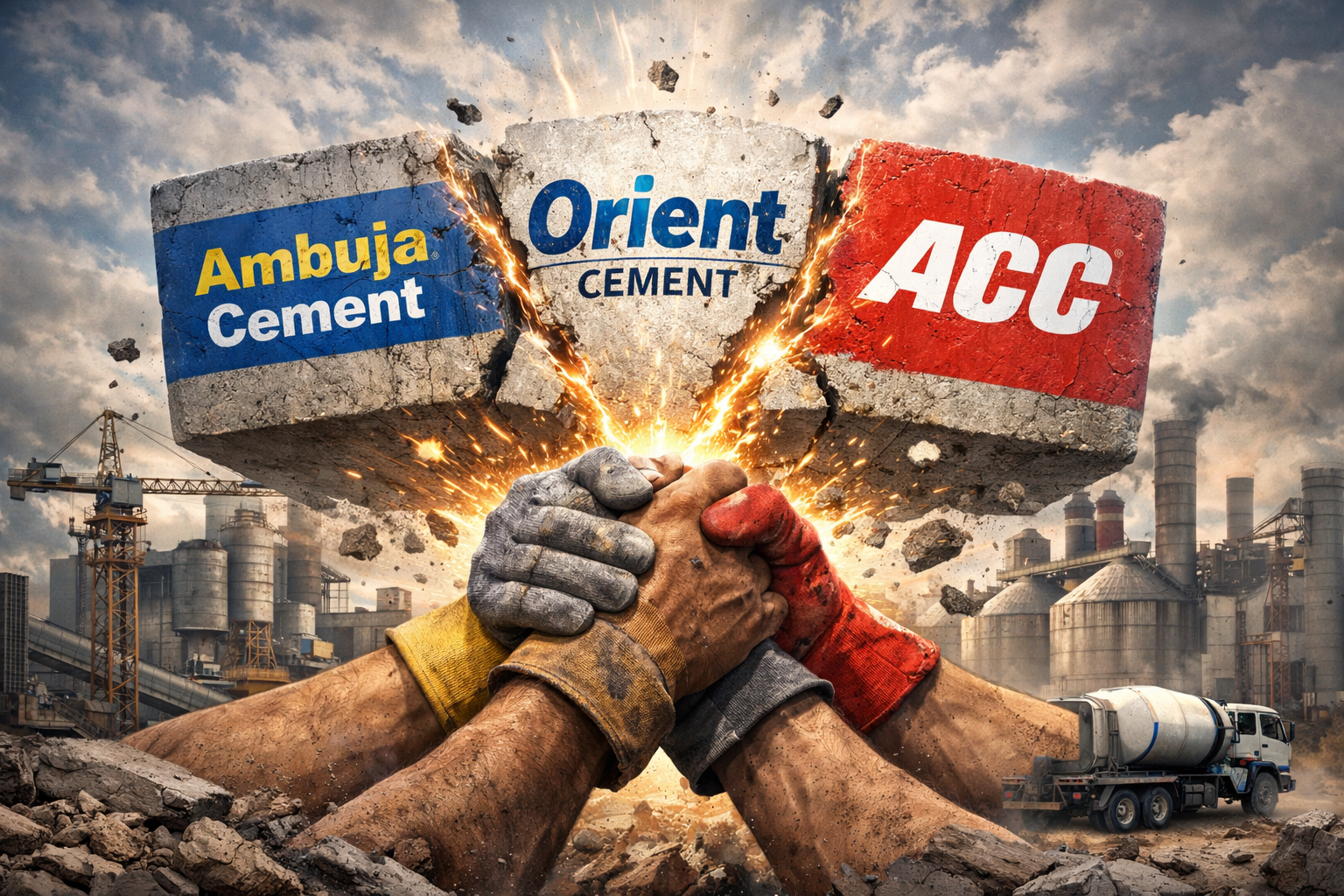
To read the RA disclaimer, please click here