
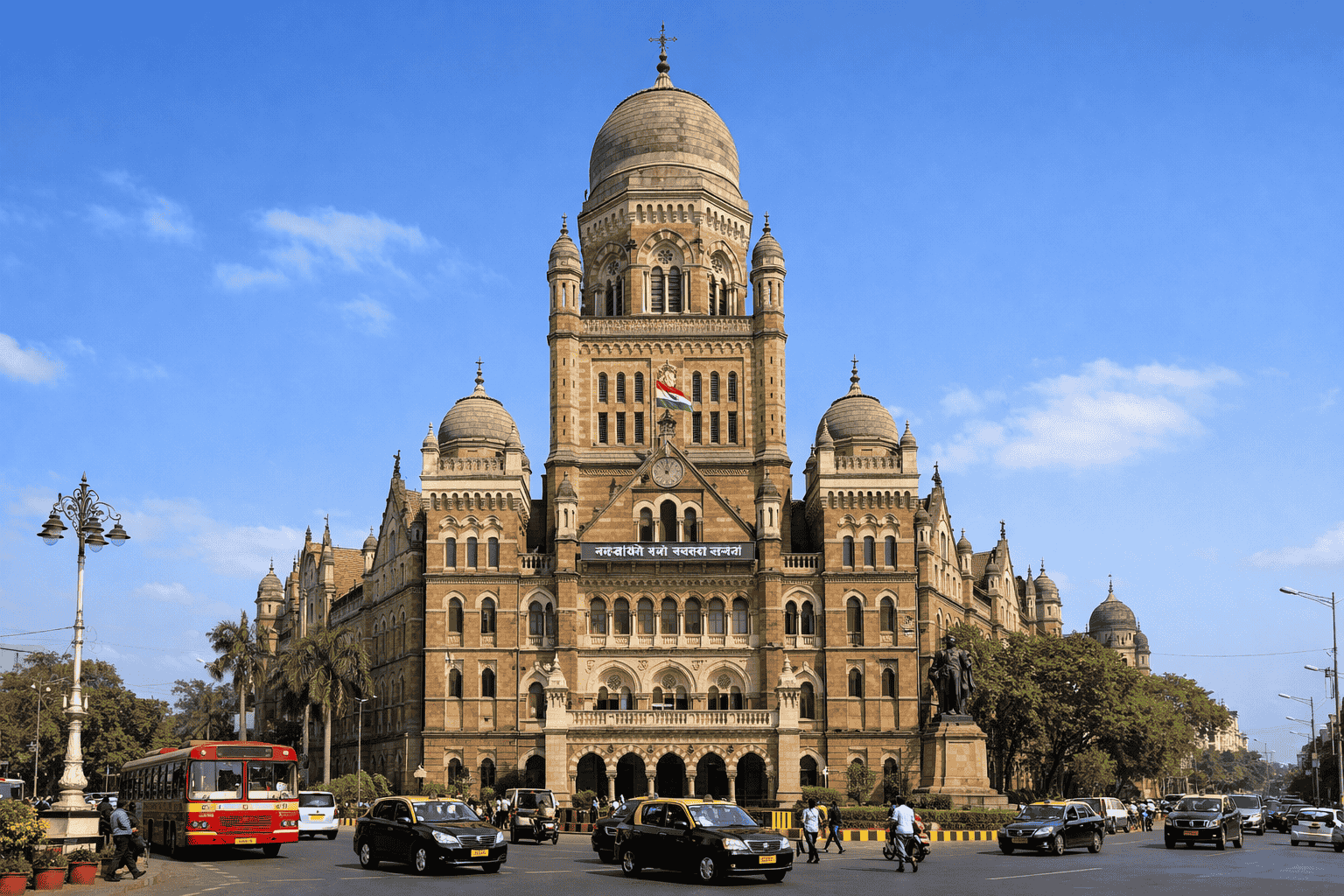
BMC Budget 2025-26: How Mumbai’s “City Government” Works, Where the Money Comes From, and Why It Matters to You
When people hear “BMC”, they usually think of potholes, garbage trucks, and monsoon flooding. However, the Brihanmumbai Municipal Corporation (BMC) is much larger; it governs Mumbai’s day-to-day life as a city-level government. And its financial power is substantial: for FY 2025–26, BMC’s budget is about ₹74,366.76 crore, larger than the annual budgets of several Indian states.
This blog breaks down, in simple words, what BMC does, how it earns, where it spends, and how BMC development schemes impact (1) the life of a common Mumbaikar and (2) the financial markets and business ecosystem around Mumbai.
1) What exactly is BMC, and why is it so Powerful?
Think of BMC as Mumbai’s main civic engine. It is responsible for core city services, the stuff you notice only when it goes wrong:
Water supply and distribution
Sewerage and drainage (including stormwater drains)
Roads, footpaths, street lights, and basic city infrastructure
Solid waste management (garbage collection, transport, disposal)
Public health services: civic hospitals, dispensaries, vaccination drives, epidemic control
Primary education through municipal schools and support infrastructure
Disaster management and emergency preparedness
Fire brigade and several civic permissions/approvals related to buildings, shops, and urban services
BMC’s own administrative description highlights its role in developing and maintaining civic infrastructure, such as water supply, roads, stormwater and drainage, and service delivery to citizens.
Broadly, civic responsibilities (roads, sanitation, hospitals, waste management, sewerage, water supply, epidemic prevention) are also commonly listed as core municipal functions.
Who runs BMC?
Operationally, the Municipal Commissioner is the principal executive authority, supported by multiple departments (roads, water, SWD, health, education, and solid waste, among others). In an elected-cycle model, corporators represent wards; however, when elections are delayed, administration is more directly overseen by appointed leadership (a frequent point of public debate in Mumbai).
2) The headline number: What is BMC’s 2025-26 budget?
For FY 2025–26, BMC has presented a budget of roughly ₹74,366.76 crore (figures may appear as ₹74,366 crore / ₹74,366.76 crore in reports depending on rounding and document versions, but the widely cited estimate is ₹74,366.76 crore).
Capital spending is the big story
A major portion is capital expenditure (big assets and long-term projects). One widely reported figure is ₹43,162 crore allocated for capital expenditure.
In plain English: BMC isn’t just paying salaries and running costs; it’s investing heavily in building and upgrading Mumbai.
3) Where does BMC earn its money from?
BMC’s strength comes from a mix of:
A) City-linked taxes and charges
Property tax (one of the most important and stable municipal revenue streams)
Development-related charges/fees, permissions, premiums, and related receipts linked to construction and city development
User fees from certain civic services, licenses, and approvals (varies by service)
B) Transfers/compensation and institutional income
Mumbai used to have “octroi” (a local entry tax). After the octroi was replaced, municipal bodies relied on compensation/alternative mechanisms. Many reports on BMC’s revenue cite compensation and development-linked receipts as significant drivers.
C) Interest income and investments (a quiet superpower)
BMC is often described as India’s richest civic body, partly because of historically large reserves held in instruments such as fixed deposits. Recent reports suggest that these reserves have been drawn down as infrastructure spending has increased, but the scale remains substantial.
Why this matters: When a civic body has large reserves, it can fund projects without being fully dependent on state or central grants.
4) Where does BMC spend the money?
BMC spending is generally split into:
Revenue expenditure: operations, salaries, routine maintenance, healthcare operations, and daily city services
Capital expenditure: roads, drains, sewage plants, major upgrades, new facilities, large-scale infrastructure
Key spending buckets that directly touch citizens
(1) Public Health: hospitals, clinics, vaccinations
BMC is one of the largest public health care providers in Mumbai. In the 2025–26 budget speech documents, the Health Department allocations are shown as:
₹5,207.70 crore (Revenue)
₹2,172.73 crore (Capital)
for BE 2025–26.
That means: running hospitals day-to-day + spending on equipment, upgrades, and facilities.
(2) Storm Water Drains (SWD) and monsoon resilience
Mumbai’s monsoon problems are not just “rain issues”; they’re infrastructure issues. A BMC budget analysis document notes allocations for the Storm Water Drain Department as:
₹839 crore (Revenue)
₹2,200 crore (Capital)
in BE 2025–26.
This is primarily flood-prevention funding: desilting, drainage upgrades, pumping capacity, and resilience projects.
(3) Solid Waste Management (garbage, cleanliness)
Solid waste management is a massive daily operation. Mumbai generates large quantities of waste, and the waste management system encompasses collection, transport, processing, and disposal. BMC’s SWM documentation discusses the scale and operational structure of waste management.
Even if you don’t “see” it, this is one of the most resource-heavy civic services in a dense city.
(4) Climate-aligned and sustainability spending
BMC has been formally tracking “climate-related” budget alignment. Reporting indicates BMC allocated a significant portion of its capital spending to climate-linked projects (flood resilience, waste, energy, transport-related initiatives, etc.).
This matters because Mumbai’s biggest threats (flooding, heat stress, air quality, waste load) are increasingly climate-linked.
5) What does “development schemes” mean in BMC language?
When people say “BMC development,” it usually means city upgrades like:
Road concretisation/road rebuilding
Drainage upgrades and monsoon desilting
Sewerage treatment plant modernisation and network expansion
Hospital upgrades, new facilities, and equipment
Ward-level works: footpaths, street lighting, public toilets, gardens, markets
Waste processing improvements (biomethanation, segregation systems, local sheds, etc.)
A civic-focused report on ward-wise budgets highlights that ward allocations include amenities such as SWM, stormwater drains, roads, footpaths, gardens, markets, public health, and slum-related provisioning.
So BMC schemes aren’t “free giveaways”, they’re practical city-building programs.
6) How BMC spending changes the life of a common Mumbaikar
Here’s the real-world translation:
A) Water + sewage + drainage = fewer daily disruptions
Better drainage and desilting reduce waterlogging, delays, and property damage.
Sewerage upgrades reduce the risk of contamination and improve hygiene.
B) Roads + footpaths = time savings and safety
Better roads reduce vehicle damage, commute stress, and accident risk.
Better footpaths are critical in Mumbai because walking is the primary “last mile.”
C) Healthcare spending = cheaper, faster access in a costly city
BMC hospitals and clinics are a lifeline for middle- and lower-income families. Bigger health allocations can translate into:
better equipment,
more capacity,
faster diagnostics,
improved preventive care (vaccination, surveillance).
D) Cleanliness + waste management = health outcomes
Better waste handling isn’t just “nice aesthetics.” It reduces:
mosquito breeding,
disease spread,
rodent issues,
and improves general living conditions.
E) The hidden impact: property values and neighbourhood quality
Areas that receive consistent civic upgrades often become more livable, and over time this is reflected in rent demand, commercial activity, and property desirability.
7) How BMC development impacts the financial markets (and businesses)
BMC doesn’t directly “move Nifty” every day, but it strongly influences cash flows, contracts, urban productivity, and investor sentiment around Mumbai’s economy.
A) Infra spending creates a contractor economy (and supply chain demand)
Large capex budgets translate into tenders and orders for:
construction contractors,
cement and steel supply chains,
road materials,
equipment vendors,
waste processing vendors,
medical equipment suppliers for hospitals.
This benefits both:
listed companies (indirectly, through demand),
and thousands of SMEs and contractors who form Mumbai’s civic supply chain.
B) Banking and liquidity angle (BMC reserves + deposits)
BMC has historically held large reserves (including fixed deposits). When reserves are drawn down to fund infrastructure, the funds flow into projects, payments, wages, and procurement, thereby boosting economic activity. Recent reports note a decline in BMC fixed deposits as funds shift into infrastructure and allocations to agencies such as BEST/MMRDA, underscoring how reserve usage is linked to project pace.
C) Productivity = economic growth = better business sentiment
A city that floods less, moves faster, and has better public health is a city where:
businesses lose fewer working hours,
logistics improves,
consumer spending becomes steadier,
and overall confidence improves.
This is not “one stock goes up tomorrow” logic; it’s slow but powerful compounding at the city level.
D) Governance and credibility matter for long-term capital
Markets value predictability:
transparent tendering,
disciplined spending,
realistic project pipelines,
stable revenue collection.
When a civic body as large as BMC spends aggressively, investors and lenders also look at liabilities, reserves, and sustainability of spending, especially because Mumbai’s infrastructure pipeline is enormous.
8) The takeaway: Why BMC’s budget deserves attention
BMC’s budget is not just a “municipal news story.” It is a blueprint for:
How Mumbai will handle flooding,
how it upgrades hospitals,
how smoothly the city runs,
and the extent of the city's economic momentum.
With a budget of approximately ₹74,366.76 crore and substantial capital spending, BMC is effectively one of the largest “public investors” in India at the city scale.
For the general public, it determines whether daily life feels smoother or chaotic. For markets and businesses, it shapes demand, liquidity flows, and long-term confidence in Mumbai’s economic machine.
Conclusion
The BMC budget is much more than a list of expenses it is Mumbai’s growth plan. With over ₹74,000 crore to spend, BMC decides how well the city’s roads, hospitals, drainage, water supply, and public services will work, directly shaping the daily life of every Mumbaikar. At the same time, this spending fuels economic activity by creating demand for construction, services, and local businesses, thereby sustaining Mumbai’s economy.
In simple terms, when BMC spends wisely, the city becomes easier to live in and more attractive for business and investment. A stronger, better-run Mumbai benefits both its people and its financial future.
SOURCES
MC Budget Estimate 2025–26 (Official Government Document): The Budget Estimates for fiscal year 2025–26, published by the Brihanmumbai Municipal Corporation (MCGM), include detailed figures and departmental allocations.
BMC Budget Speech Document (English)
The official budget speech with figures and descriptions of allocations (Capital & Revenue).BMC Budget 2025–26 Datasets (OpenCity)
Downloadable datasets, including “Budget at a Glance” and breakdowns by fund/category.Official BMC Website Budget Portal
The official portal where Budget Estimate documents, Annual Accounts, and disclosures are published.
Times of India — BMC Unveils ₹74,366 Crore Budget (Key Numbers)
Report on the total size of the budget and capital expenditure.Moneycontrol — Record ₹74,427 Crore BMC Budget
Highlights the record nature of the budget and revenue projections.Indian Express — Budget Splits (Capex vs Revenue)
Breakdown of total budget into capital and revenue components.Upstox — Budget Growth Context & Percentage Increase
Shows how the 2025–26 budget compares with last year’s allocation.OpenCity CKAN — Budget Estimates PDF (Funds A & B)
Useful if you want to embed direct figures or screenshots in your blog.
BMC Budget Key Highlights Video (NDTV) LinkedIn Insight — Budget Trend Table (Historical Context)
Useful if you plan to embed or link an explainer video.
Shows year-on-year shifts in focus and allocations.