
US military action in Venezuela poses minimal risk to India's economy. Venezuela's oil output is low, and India imports negligible amounts from there, relying mainly on diversified sources like the Middle East and Russia. Short-term oil price volatility may affect refiners and aviation briefly, but India's reserves and policy tools absorb shocks easily. Stock indices like Nifty and Sensex see only fleeting reactions, ignore headlines, and focus on fundamentals. At first glance, it sounds serious. Venezuela has some of the world’s largest oil reserves, and any disruption there feels like it should shake global markets. However, when we examine the data and India’s current energy position, the reality is more nuanced and far less dramatic than headlines suggest. This blog explains, in simple words, what actually happened, why Venezuela matters, and how much this really impacts India without panic, hype, or jargon. Venezuela has been facing political instability, economic collapse, and international sanctions for many years. Its oil industry, once a global heavyweight, has been operating far below capacity due to poor infrastructure, lack of investment, and restrictions on exports. The US military action and increased intervention were aimed at changing political control and securing influence over Venezuela’s oil assets. Such events usually create short-term uncertainty in global markets because traders fear supply disruptions. But here’s the key point: Venezuela’s oil production today is only a fraction of what it used to be. At its peak, the country produced over 3 million barrels per day. Today, production is closer to 800,000–900,000 barrels per day, less than 1% of global supply. That context matters a lot. For decades, Venezuela was a major supplier of heavy crude oil, especially to the US and parts of Asia. But years of mismanagement, sanctions, and underinvestment have dramatically reduced its role. Today: Venezuela is not a swing producer that can move oil prices on its own. Most refineries globally have already adjusted to reduced Venezuelan supply. Other producers like the Middle East, Russia, and the US itself dominate global oil flows. So while the news sounds big, the actual supply risk is limited. India imports around 85% of its crude oil needs, which naturally makes oil prices a sensitive issue for inflation, fiscal balance, and currency stability. However, India’s oil sourcing is highly diversified: Middle Eastern countries supply the bulk of imports Russia has emerged as a major supplier in recent years Smaller volumes come from Africa and Latin America Venezuela, at present, contributes almost nothing to India’s daily oil imports due to sanctions and payment restrictions. This is why experts say the direct impact on India’s energy security is negligible. Whenever geopolitical conflict involves oil-producing nations: Oil prices may spike temporarily Traders price in “risk premium.” Volatility increases for a few days or weeks This is more about fear and speculation than actual shortages. Once markets digest the facts: Prices stabilise if the physical supply is unaffected Focus shifts back to global demand, OPEC decisions, and economic growth In Venezuela’s case, since production was already low, there is no meaningful loss of supply to shock the market. If anything, increased US involvement could eventually lead to higher Venezuelan output, which would add supply and put downward pressure on prices over time. India’s oil import bill depends on: Average crude price Import volume Rupee-dollar exchange rate A brief spike in oil prices does not automatically translate into a crisis. Even if crude prices rise by $2–3 per barrel temporarily: The impact on India’s annual import bill is manageable Government buffers, excise duties, and strategic reserves help absorb shocks As long as oil stays within a broadly stable range, India’s macro stability remains intact. Historically, geopolitical events that do not directly involve India have limited and short-lived impact on benchmark indices. Why? India’s growth story is driven by domestic consumption, capex, and services Foreign investors look at India as a long-term structural market One external event rarely changes earnings outlook meaningfully So don’t expect sustained panic selling across the market. Some sectors may see short-term moves: Oil & Gas Upstream companies may benefit if oil prices rise Refiners may see margin pressure if prices spike suddenly Marketing companies could face temporary volatility Aviation & Logistics Higher fuel costs can hurt margins Stocks may react negatively in the short term IT & Exporters Minimal direct impact Currency movements matter more than oil geopolitics Overall, these are tactical reactions, not long-term trend changes. Indian public sector companies, especially ONGC Videsh Ltd, have investments and unpaid dues in Venezuela. Due to sanctions: Payments were stuck Oil-for-debt arrangements were disrupted Capital recovery was delayed If political control stabilises and sanctions ease: India may recover outstanding dues worth roughly $1 billion Indian firms could resume limited energy cooperation This is a potential upside, not a guaranteed outcome, but it improves India’s negotiating position. In simple terms: No major shock. India’s economy today is: Driven by domestic demand Supported by services exports Backed by a growing manufacturing base Oil is important, but India is far less vulnerable today than it was a decade ago because: Inflation targeting frameworks are stronger Foreign exchange reserves are high Fiscal buffers are better managed A temporary oil price fluctuation does not derail growth or policy planning. India has multiple tools to manage oil-related shocks: Adjusting fuel taxes Using strategic petroleum reserves Diversifying import contracts Managing currency volatility via RBI interventions These mechanisms ensure that external geopolitical risks do not spiral into domestic crises. For retail investors, the key lesson is simple: Do not react emotionally to global headlines Avoid panic selling on geopolitical news Focus on company fundamentals and earnings Use volatility as an opportunity, not a threat History shows that markets recover quickly from geopolitical noise unless it directly affects domestic growth or financial stability. This event also reflects a broader trend: Energy geopolitics is shifting The US is increasingly energy-independent OPEC’s influence is balanced by non-OPEC producers India is navigating this landscape with diversification and diplomacy Venezuela, once a dominant force, is now a secondary player in global energy markets. The US action in Venezuela sounds dramatic, but when viewed through data and context, its impact on India is limited and manageable. India does not depend on Venezuelan oil Global supply remains sufficient The stock market impact is temporary Economic fundamentals stay strong For investors and readers, the biggest risk is overreacting to headlines rather than understanding the underlying reality. Hindustan Times The Hindu – Business / Economy Ministry of Petroleum & Natural Gas, Government of India International Energy Agency (IEA) U.S. Energy Information Administration (EIA) ONGC Videsh Limited – Annual Reports & Investor Disclosures Reserve Bank of India (RBI) OPEC Monthly Oil Market Reports World Bank – Commodity Markets OutlookHow the US pressure on Venezuela Impacts India’s Stock Market, Oil Bill, and Economy
What Exactly Happened in Venezuela?
Why Venezuela Is Not as Powerful in Oil Markets Anymore
India’s Oil Dependence: The Big Picture
Impact on Crude Oil Prices: Short-Term vs Long-Term
Short-Term Reaction
Medium to Long Term
What This Means for India’s Oil Import Bill
Impact on the Indian Stock Market
Broad Market (Nifty, Sensex)
Sector-Wise Impact
What About Indian Companies Stuck in Venezuela?
Does This Affect India’s Economy Overall?
How Policymakers Usually Respond
What Should Investors Do?
The Bigger Global Context
Final Thoughts: Calm Over Chaos
SOURCES
How US attack on Venezuela impacts India’s stock market, crude oil bill, economy
Venezuelan situation to have negligible impact on India’s energy security, data shows
Data on India’s crude oil import dependence and sourcing diversification
https://mopng.gov.in
Global oil production, supply-demand balance, and country-level output estimates
Venezuela's oil production trends and historical output data
Information on Indian investments and outstanding dues in Venezuela
https://www.ongcvidesh.com
Data on foreign exchange reserves, inflation management, and macro buffers
Context on global oil supply, non-OPEC production, and market stability
Oil price sensitivity, geopolitical risk premium, and emerging market exposure
Blogs / How the US pressure ...
How the US pressure on Venezuela Impacts India’s Stock Ma...
2026-01-06 · 5 min
Sector - Finance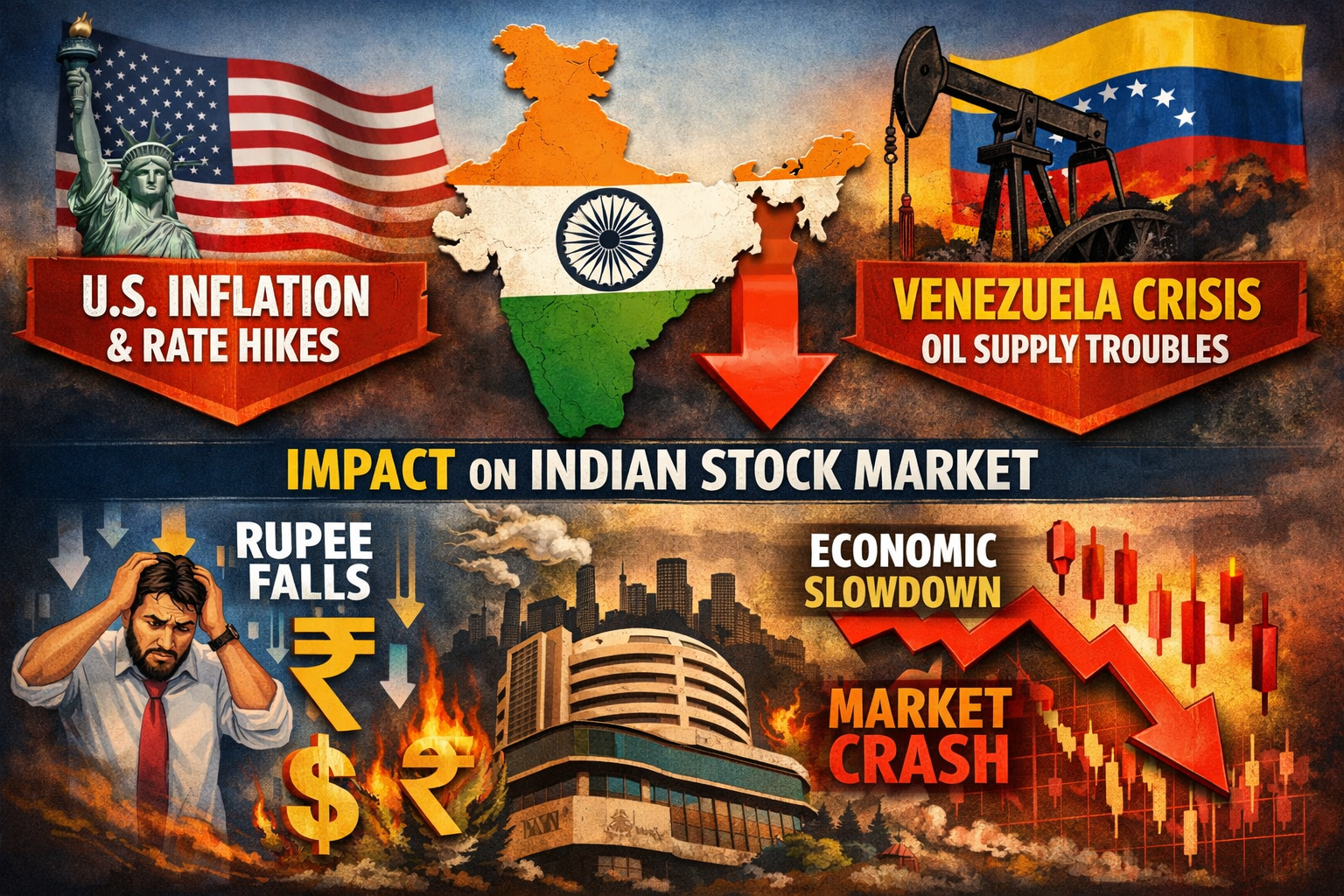
To read the RA disclaimer, please click here