
I still remember the first time I heard “AI will be as basic as electricity.” It sounded like a line from a keynote. Today, it feels like a business plan, especially in India. Because in the middle of Mumbai’s monsoon headlines, Mukesh Ambani’s Reliance and Mark Zuckerberg’s Meta quietly put down a marker: a ₹855 crore (₹8.55 billion) joint investment to build, package, and distribute enterprise AI solutions for Indian companies. Not another lab demo. Not a hackathon. A full-blown venture to productize AI for the real economy. Think of this partnership as an arranged marriage of strengths. Meta brings its Llama family; open-source, developer-loved, and increasingly enterprise-ready. Reliance brings distribution at Indian scale; telecom, retail, media, B2B relationships, and the political will to build. The JV’s charter is simple on paper, ambitious in practice: agentic enterprise AI platforms and pre-configured solutions that can drop directly into sales, support, finance, IT operations, and industry-specific workflows. In short, “don’t sell me a model, solve my task.” If you’ve ever tried taking a clever demo to a factory floor, a hospital, a bank branch, or a government office, you know why this matters. Most Indian enterprises don’t want to wrangle GPUs, fine-tuning pipelines, and governance checklists. They want time-to-value and predictable cost. The JV is pitching exactly that, with Platform-as-a-Service + a shelf of ready solutions, deployable on cloud, on-prem, or hybrid; where a lot of Indian workloads still live. The initial war chest is ~₹855 crore (about US$100 million). Reports and filings indicate Reliance will own 70% through its AI arm (Reliance Intelligence) and Meta will take 30%, a structure that lets Reliance anchor go-to-market while Meta hardens Llama for mission-critical use. The entity popping up in headlines is Reliance Enterprise Intelligence Limited (REIL). The ambition is not a side project: it’s a vehicle to develop, market, and distribute AI services to Indian enterprises and SMBs at scale. If the figures feel familiar, that’s because this pair has danced before. Back in 2020, Meta wrote a $5.7 billion cheque into Jio Platforms to fuel India’s digital rails, from payments to small-merchant e-commerce. That partnership taught both sides an enduring lesson: in India, distribution eats strategy for breakfast. This AI JV is the sequel with a more technical script. Three reasons. 1) The model moment: Llama’s open posture reduces total cost of ownership and offers auditable control which is the key to Indian CIOs who juggle data sovereignty, compliance, and budget discipline. Meta’s note explicitly emphasizes lower TCO and enterprise-grade readiness based on proven production deployments. Translation: this isn’t a research toy anymore. 2) The infra moment: Reliance has been signaling a huge AI infrastructure buildout, From data centers to chips, so products that fully utilize that stack make strategic sense. Analysts peg Reliance’s AI infra ambitions in the $12–15 billion range over time, including a multi-phase data-center program. Infra without software is a cost center; infra with software is a moat. 3) The India moment: The SMB-to-enterprise pyramid in India is starving for automation that’s priced and packaged for our reality. The JV’s promise of “ready to deploy” vertical solutions like BFSI onboarding and KYC, multilingual support bots for retail, preventive maintenance for manufacturing, document-heavy workflows in logistics or healthcare which speaks exactly to that gap. Picture a bank with 3,000 branches and 12 languages across customer touchpoints. The JV could offer: A governed LLM workspace where the bank’s data stays inside its perimeter, with policy-based controls and audit logs. Plug-and-play bots for collections that understand Hinglish and regionals, escalate to humans with full context, and log every action for compliance. Ops co-pilots for IT teams that watch logs, flag anomalies, and auto-remediate common issues. Now switch the logo to a hospital chain, an auto supplier cluster, or a state department digitizing citizen services, the contours stay similar: faster deployments, lower integration pain, and measurable ROI. A few important notes tucked into the announcement: Regulatory approvals are still a step; the JV targeted Q4 2025 for closing. In India, timelines can shift, but the signal is strong enough for customers and partners to start planning pilots. Media coverage reiterates the ₹855 crore as an initial commitment,leaving room for follow-on capital as adoption scales. That’s typical for platform bets where infra, data contracting, and solution libraries deepen over time. Enterprise AI is not just GPUs and good intentions. There are real risks: Change management is the invisible cost. If the JV’s “pre-configured” slate isn’t opinionated enough, deployments will bog down in customization. If it’s too rigid, value won’t materialize. Data quality is destiny. Many Indian enterprises have messy data estates; the JV’s promise will hinge on connectors, clean-room patterns, and governance out-of-the-box. Benchmark-proofing Llama. Open-source is a strength, but regulated sectors will demand consistent latency, security posture, and fallback guarantees. Meta and Reliance will need published SLAs, eval suites, and reference wins. Even with those caveats, this partnership checks three boxes that most AI press releases don’t: A clear buyer: Indian CIOs who already buy from Reliance’s ecosystem. A clear product frame: platform + solutions, not “we’ll figure it out.” A clear cost story: open-source base models, hybrid deployment, and Indian pricing power. Add the historical context, Meta’s earlier bet on Jio and you can see the arc: from connectivity → commerce rails → intelligence layer. If the JV can nail three lighthouse deployments in BFSI, retail, and manufacturing, it will create a copy-paste playbook for the rest of the market. And once that happens, ₹855 crore won’t look like a big number; it’ll look like a seed round for India’s AI operating layer. Reliance Industries media release: “Reliance and Meta Partner for Enterprise AI Solutions for India” outlines the JV, ~₹855 crore initial investment, Llama-based platforms, deployment options, and expected Q4 2025 closing. Business Standard: Coverage of the Reliance–Meta AI joint venture; reports 70/30 ownership and ~₹855 crore initial commitment. (Business Standard) The Economic Times (Tech): Round-up on the enterprise AI JV and the ₹855 crore initial pool; additional details on Reliance Intelligence. (The Economic Times) Tech in Asia: Notes the new entity REIL and the ₹855 crore (~US$97.3m) funding figure. (Tech in Asia) Times of India (Tech/Business): Reports the Reliance–Meta partnership and recalls Meta’s $5.7bn 2020 investment in Jio Platforms for context. (The Times of India)The meeting point: scale meets software
The money, the cap table, the message
Why “enterprise AI” and why now?
What might this look like on the ground?
The fine print (that matters)
Risks and the execution riddle
Why this still feels like a turning point
Sources & further reading
ET Markets (analysis): On Reliance’s broader AI infra ambitions ($12–15bn), signaling the larger context into which the JV fits. (The Economic Times)
Blogs / ₹8.55 Billion and a ...
₹8.55 Billion and a handshake: Inside Reliance × Meta’s b...
2025-10-28 · 5 min
Sector - Business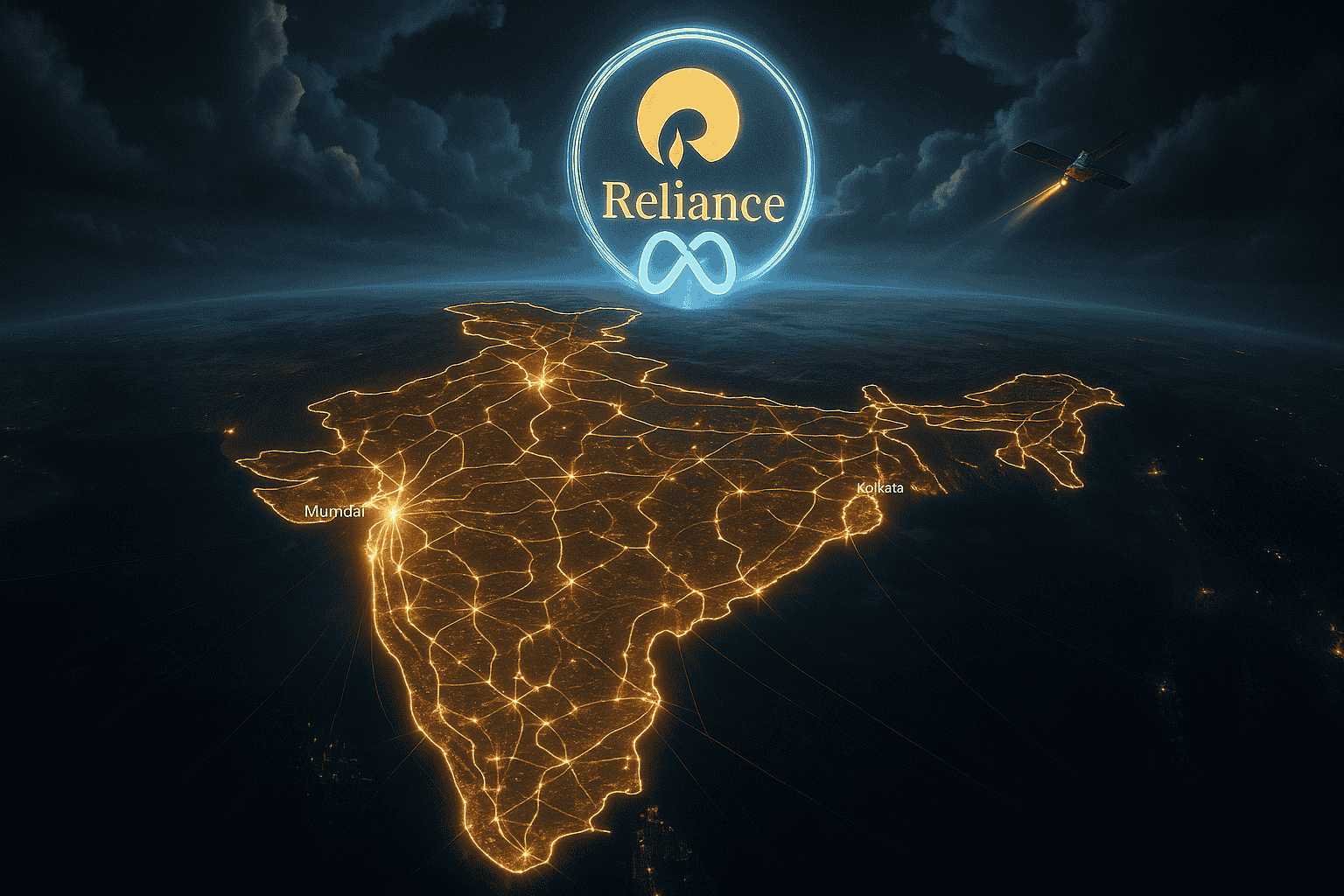
To read the RA disclaimer, please click here