
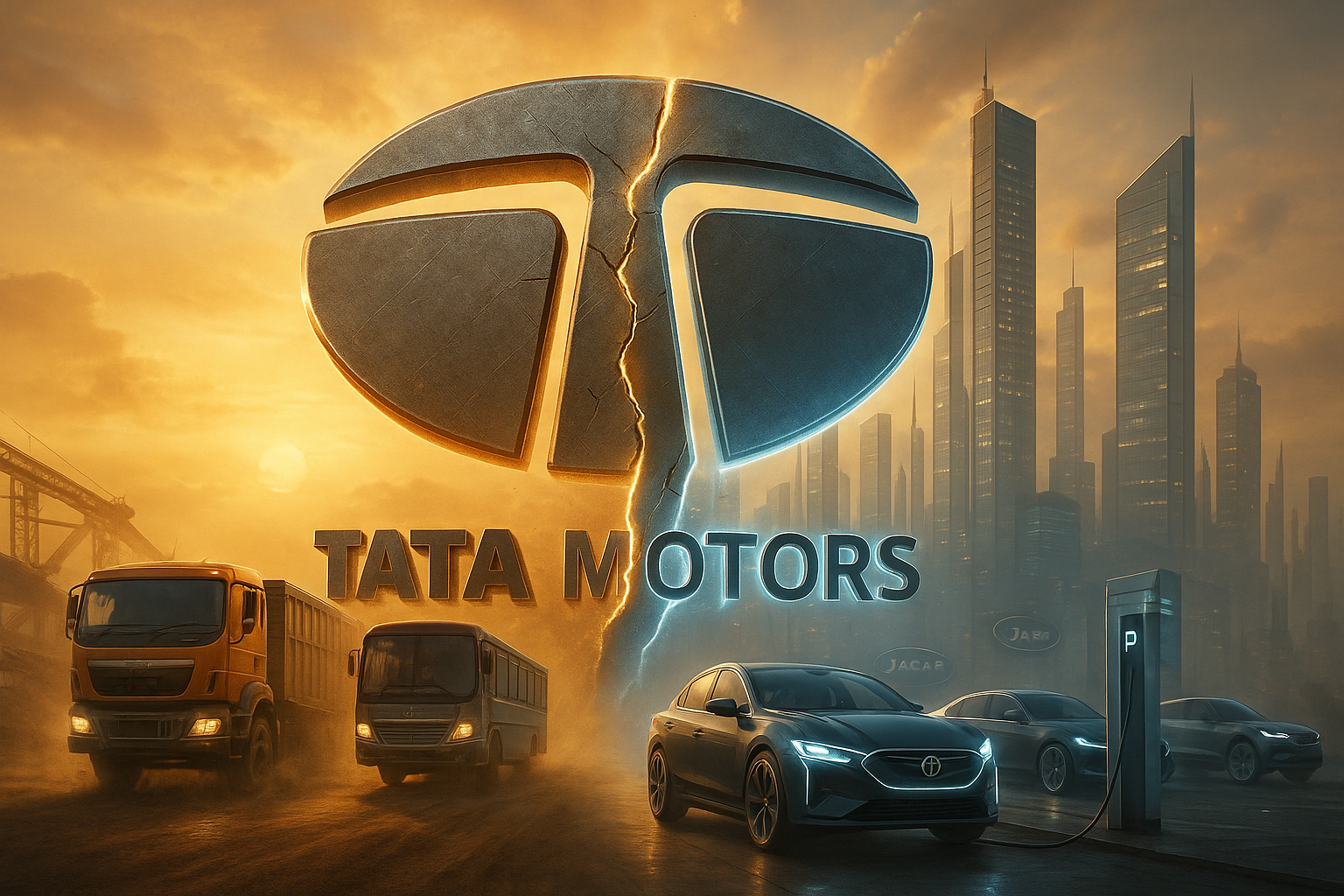
It was a humid Tuesday afternoon in Mumbai when the news began to ripple through the financial circles: Tata Motors, India’s automotive colossus would officially divide itself into two separate listed companies.
At first, the headlines were almost unbelievable. For over seven decades, Tata Motors had been the beating engine of India’s industrial story. From the dusty roads plied by its trucks to the gleaming showrooms displaying its electric Nexon EV and the British-born Jaguar Land Rover (JLR). And now, the behemoth was voluntarily splitting its own heart in two.
What followed was not just a corporate restructuring, but one of the most dramatic and symbolic episodes in Indian business history. A story of identity, reinvention, and the art of unlocking value in a fast-changing world.
Chapter 1: The “Why” Behind the Split
To understand the “why,” we have to rewind a bit.
Tata Motors was, for decades, an odd hybrid, part mass-market truck manufacturer, part luxury car player. One half was deeply Indian, rooted in the commercial vehicles (CV) business that built buses, trucks, and defense carriers. The other half, after Tata’s bold 2008 acquisition of Jaguar Land Rover, was global, premium, and aspirational.
But as analysts often noted, that dual identity came at a cost. Investors found it difficult to assign fair valuations to the company. “The two businesses were pulling in opposite directions,” said one analyst in a Reuters report. “Commercial vehicles are cyclical and depend heavily on economic growth; JLR and passenger vehicles are driven by brand and consumer sentiment.” (Reuters, Mar 2024)
The board finally decided to do something bold. In March 2024, Tata Motors announced that it would demerge into two distinct listed entities ; one focusing on commercial vehicles (CVs), the other on passenger vehicles (PV), electric vehicles (EVs), and JLR.
Under the plan, each Tata Motors shareholder would receive one share in the new PV company for every share they owned in Tata Motors Ltd. The appointed date for this separation was July 1, 2025, with October 14, 2025, marked as the record date for determining eligible shareholders. (GoodReturns, 2025)
Chapter 2: The Calm Before the Split
As the demerger date approached, market chatter intensified. Some called it a “masterstroke,” while others feared chaos.
In early October 2025, the stock started showing tremors. Over just seven trading sessions, Tata Motors’ share price slipped nearly 7%. It wasn’t panic, it was anticipation. Investors knew that after the record date, the price would be adjusted to reflect only the CV division’s value. (Economic Times, Oct 2025)
Analysts began calling it one of the most closely watched demergers in Indian corporate history, a move that could potentially reshape Tata Motors’ market story forever.
On social media, investors were abuzz. One X (formerly Twitter) user joked, “Owning Tata Motors feels like watching your parents announce an amicable divorce. Confusing, but maybe for the best.”
Chapter 3: October 14, The Day of Reckoning
When the markets opened on October 14, 2025, Tata Motors’ stock crashed or at least that’s what it looked like.
The share price fell almost 40%, plummeting from ₹660.90 to around ₹399. But in reality, this wasn’t a “crash.” It was a mathematical adjustment, the PV entity’s value had been stripped out to prepare for the new listing. (Economic Times, 2025)
Bloomberg reported that post-demerger, “shares began trading without the value of its commercial vehicles business,” confirming the technical nature of the decline. (Bloomberg, Oct 2025)
For ordinary investors, though, it was a roller coaster. Many panicked at the sight of the sharp dip before realizing that they now effectively owned two valuable companies instead of one.
Chapter 4: What Shareholders Should Know
So, what did this mean for Tata Motors’ lakhs of shareholders?
- Automatic Credit: Shareholders didn’t need to lift a finger. The new PV entity’s shares would be automatically credited to their Demat accounts in a 1:1 ratio.
- Temporary Dip: The old Tata Motors price fell because it no longer included the PV division’s value.
- New Listing Ahead: The new PV + JLR + EV entity would be listed within 45–60 days post-record date.
- Tax Treatment: The cost of acquisition for your Tata Motors shares would be proportionately split between the two new entities.
- Two Separate Stories: Investors could now choose to keep both, or favor one side of the business depending on their conviction. (GoodReturns, 2025)
This was not a free lunch. Those who rushed to buy Tata Motors stock after the ex-date learned the hard way that the split value was already “priced in.”
Chapter 5: Beyond the Balance Sheet
To really grasp the significance of this moment, you have to see it beyond spreadsheets.
This split is also a story about how India’s largest industrial group, the Tata conglomerate is learning to evolve with the times.
In the commercial vehicles business, Tata has been looking outward. In mid-2025, the company struck a landmark €4.5-billion deal to acquire Iveco’s truck and bus division, giving it instant access to European technology and markets. (Reuters, Jul 2025) That single move could make Tata’s CV arm one of the top global truck players.
Meanwhile, on the PV side, the focus remains squarely on EV leadership and JLR’s transformation. But 2025 wasn’t kind to JLR, a cyber-attack temporarily shut down production and hit its quarterly sales. (Reuters, Oct 2025)
And as if that weren’t enough, the Tata Group itself faced boardroom turbulence, wiping out over ₹4 lakh crore in market value across Tata stocks. (Economic Times, 2025)
So, while the split may look neat on paper, the road ahead is anything but smooth.
Chapter 6: A Tale of Two Futures
If you were to anthropomorphize the two new Tata Motors entities, they’d almost feel like siblings with different personalities.
The Commercial Vehicle Company: Strong, rugged, predictable. It is the dependable elder child, built on decades of trust and industrial heritage. It will cater to India’s infrastructure boom, fleet demand, and logistics expansion.
The Passenger Vehicle Company: By contrast, is the adventurous younger sibling. More global, tech-driven, and ambitious. It holds Tata’s EV dreams, JLR’s prestige, and India’s middle-class aspirations in one portfolio.
Both are vital. Both carry the Tata legacy. But now, they no longer have to share one body.
Chapter 7: The Investor’s Lens
Every demerger tells two stories: one about the company, and one about investor psychology.
When companies split, the short-term market reaction is usually chaotic. Prices tumble, algorithms panic, and social media amplifies confusion. But over time, clarity emerges.
Historically, Indian corporate demergers from HDFC Bank-HDFC to Reliance’s Jio Financial Services spin-off, both have shown that clean separations often unlock hidden shareholder value once the dust settles.
If Tata Motors can execute well on both fronts, turning its CV business global and its PV arm future-ready. Analysts believe it could become a multi-trillion-rupee ecosystem within a decade.
Chapter 8: The Moral of the Story
In the end, this isn’t just about a company splitting its assets. It’s about evolution.
Tata Motors is doing what most legacy giants hesitate to do. Reimagine themselves before the world forces their hand.
For shareholders, this means not just owning a piece of history, but a share in two different futures:
- One powered by diesel, steel, and global expansion,
- And the other by electric dreams, luxury craftsmanship, and digital innovation.
As the markets close each day and analysts debate the “true” value of Tata Motors 2.0, one thing is clear, this isn’t an end. It’s a metamorphosis.
References (for credibility and citation):
- Reuters – Tata Motors jumps on plan to split into two listed firms
- GoodReturns – Tata Motors 1:1 demerger record date update
- Economic Times – Stock slides 7% in 7 days pre-demerger
- Bloomberg – Tata Motors trading post spin-off
- Reuters – Tata’s €4.5 billion Iveco acquisition
- Economic Times – Tata Group boardroom turmoil impact